
Posted Monday, October 20, 2014 - 10:55
Wednesday, December 17, 2014
So you want to make a flowchart?
Here's a link to my most recent AISL post, on the process of making a flowchart about library donation policies. http://aislnews.org/?p=1922
Friday, December 5, 2014
College Napping Room
I just slept by my books in the overnight library (Shoutout to the Hut!) or occasionally by pulling together two cushy chairs and making a little nest. Coats make great pillows and blankets...
Children today are so privileged... :) :)
Summary: Wake Forest library has created a nap room with recliners and no studying or technology allowed.
https://www.insidehighered.com/news/2014/12/04/wake-forest-u-creates-room-napping-campus-library
Children today are so privileged... :) :)
Summary: Wake Forest library has created a nap room with recliners and no studying or technology allowed.
https://www.insidehighered.com/news/2014/12/04/wake-forest-u-creates-room-napping-campus-library
Tuesday, November 25, 2014
It's Thanksgiving...and 10 list time!
I can't help but feel a little cheesy for this, but "Tis the Season" as they say.
As you begin to celebrate Thanksgiving (and a looonggg weekend for those of you in schools), here are things that I am thankful for this year.
1. New Overdrive MISBO consortium collection that adds 2000 fun electronic reading options to our print collections. (They can easily be accessed over the holidays as you're reading this and the library doors are closed.)
2. Invitations to listen to student presentations after I've helped students research a topic all fall.Especially when students thank me for visiting their class!
3. My advisory's willingness to discuss anything that is on their minds, and their respect for the voices of their peers.
4. The beautiful view from my library windows with Spanish moss-draped trees and the bayou in the distance.
5. A dedicated, fun-loving group of Bay Area librarians who can't wait to show off the Tampa Bay area to colleagues around the country this April.
6. Colleagues who are willing to step out of their comfort zone to try blogging with students around the world about current events.
7. Favorite authors writing new books, and the time to read those books while falling asleep each night.
8. Instagram account that showcases all of the roles I have on a daily basis.
9. Renovation and redecoration of the Campus Center Library with more space, new shelving (new books!) and beautiful artwork taken from children's literature
10. A job that allows for continual self-growth and has defined breaks where everyone returns refreshed and ready to begin again on the road to education.
Now eat your turkey or tofurky and be fully present for those in your lives.
As you begin to celebrate Thanksgiving (and a looonggg weekend for those of you in schools), here are things that I am thankful for this year.
1. New Overdrive MISBO consortium collection that adds 2000 fun electronic reading options to our print collections. (They can easily be accessed over the holidays as you're reading this and the library doors are closed.)
2. Invitations to listen to student presentations after I've helped students research a topic all fall.Especially when students thank me for visiting their class!
3. My advisory's willingness to discuss anything that is on their minds, and their respect for the voices of their peers.
4. The beautiful view from my library windows with Spanish moss-draped trees and the bayou in the distance.
5. A dedicated, fun-loving group of Bay Area librarians who can't wait to show off the Tampa Bay area to colleagues around the country this April.
6. Colleagues who are willing to step out of their comfort zone to try blogging with students around the world about current events.
7. Favorite authors writing new books, and the time to read those books while falling asleep each night.
8. Instagram account that showcases all of the roles I have on a daily basis.
9. Renovation and redecoration of the Campus Center Library with more space, new shelving (new books!) and beautiful artwork taken from children's literature
10. A job that allows for continual self-growth and has defined breaks where everyone returns refreshed and ready to begin again on the road to education.
Now eat your turkey or tofurky and be fully present for those in your lives.
Wednesday, November 19, 2014
Citation Theory
Here's the most recent AISL post on Citation Theory, and links to more than you ever wanted to know about different citation styles!
http://aislnews.org/?p=1837
http://aislnews.org/?p=1837
Monday, November 17, 2014
"She kind of moved to the West Coast..."
Stephen Kurutz has seen into my soul, kind of. This is particularly pertinent to generalist librarians, since each day brings hundreds of reference questions. There is no way to prepare, and with teenagers you don't want to be caught off guard. A basic knowledge of a subject gives you a gateway and an opening for further discussion. However, there's a benefit to vagueness and it allows you to start a search at the beginning, assuming no knowledge of a subject. Frequency illusion or not, I'm noticing this in my speech pattern every day and working to limit it to times of metaphor, not times when I am hedging my certainty on a subject.
The "Kind of, Sort Of" Era
http://www.nytimes.com/2014/11/02/opinion/sunday/the-kind-of-sort-of-era.html?module=Search&mabReward=relbias%3Ar&_r=0
I’VE sort of noticed something about the way we speak, and I wonder if you’ve sort of noticed it, too. Let me kind of explain. It’s about sort of, and its twin, kind of, and how these adverbial downtoners, as the British grammarian Sir Randolph Quirk calls them, have totally, completely, 100 percent taken over casual speech.Kinda, sorta.I’m not referring to their use to describe a class of something, such as a sort of mammal, but rather as hedge words, to lessen a statement’s force or meaning. For instance, here’s the University of Cambridge ecologist Peter Walsh speaking recently about Ebola: “What’s nasty about it is it sort of melts your blood vessels.”And here’s Edward J. Snowden describing his background to Brian Williams of NBC: “I was trained as a spy in sort of the traditional sense of the word.”And here’s the comedian Amy Poehler explaining how she and Tina Fey divvy up laugh lines: “It kind of figures itself out. We just have to kind of be democratic about it.”It’s possible I’m experiencing what linguists call the frequency illusion — my brain is primed to recognize the phrases, so I’m hearing them all the time. Or maybe I’ve stumbled into another linguistic pitfall, the recency illusion, thinking that a word or phrase is recent when it has actually existed for a long time. In 1995, William Safire noted in The New York Times Magazine the widespread use of kinda-sorta in the courtroom of the O. J. Simpson trial. And as far back as 1909, the language stickler Ambrose Bierce complained that “Kind of followed by an adjective, as ‘kind of good,’ is almost too gross for censure.”It may be too gross for censure, but “kind of” and “sort of” have shown staying power over the decades. If you put “sort of” into Google’s Ngram viewer, a database of millions of digitized books, you find steady usage levels through the 1980s and ’90s, and a small uptick starting in 2000. And that’s only written language, not informal speech. For anecdotal proof, listen to NPR for a few hours (though not conservative talk radio, where certainty is more the rule of law).Gabriel Doyle, who has a Ph.D. in linguistics and writes the blog Motivated Grammar, told me that “sort of”’ is a “de-precision device.” As Dr. Doyle put it: “The speaker is saying, ‘Don’t think of this as being overly accurate.’ ”In other words, people throw “sort of” into their speech because they’re unsure. Our language is reflecting modern life.We sort of have stable jobs until our company outsources or downsizes. We can sort of count on Social Security in retirement. We’re sort of done fighting a war in Iraq. It’s my nonscientific theory that “sort of” is, in part, a linguistic manifestation of the indefiniteness we feel, a noncommittal expression for a time of rapid technological change and instability across our social structures.During our phone conversation, Dr. Doyle peppered his sentences with a lot of “sort ofs,” as in: “My approach on these things is sort of, what are the sort of factors that encourage people to use this?” He was conscious of doing so, and said his “sort of” rate increased when presenting new ideas or speaking to large crowds — say, at a conference.“You don’t want to be overly confident in these high-stakes arenas,” he said.In this sense, “sort of” addresses another modern concern, because not a week goes by that someone isn’t publicly embarrassed or shamed over ill-considered words they tweeted or were caught saying on video. Daily conversation has become a high-stakes arena, for celebrities as well as normal citizens.The awareness that offhand utterances can live forever online and have serious consequences has made for overly cautious speech. So we hear the “Meet the Press” host Chuck Todd say to a reporter that he “sort of laughed” after reading an article on Benghazi in a conservative newspaper. Or Joe Neumaier, a writer for The New York Daily News, who as a film critic is paid to offer sharp opinions about Hollywood, assert about Robin Williams that “you sort of don’t think of him as a sort of character actor.”Using “sort of” to reduce the risk of making an error or causing offense is a tactic an editor friend calls “strategic softening.” (Note to Alec Baldwin: insert “sort of” in your next tirade and you won’t have to make a public apology.)As much as it can create rhetorical wiggle room and be a tool for nuanced thinking about a complex world, the “fuzzy kinda-sorta,” as Mr. Safire called it back in 1995, can also make for wishy-washy and obsequious speech that lacks clarity, confidence and authority. Especially when used frequently and to qualify banal utterances and basic facts.The other day I was listening to NPR and heard Nicolas Retsinas, a Harvard Business School professor, mention that his daughter had “kind of moved back to the East Coast” from Alaska.I doubt Mr. Retsinas was aware of saying “kind of.” It’s become a verbal tic, a filler phrase. I’ve deployed both “sort of” and “kind of” myself, many times. In this very newspaper, I once described the view from a Detroit rooftop as possessing “a sort of grandeur.” Strunk and White would not approve.Sometimes I think of epic declarative statements, and wonder how they might be rendered in today’s hedge-speak. “It was sort of the best of times, it was sort of the worst of times.” “I came, I saw, I kind of conquered.” “I sort of have a dream.”Sound kind of weak? Definitely.Steven Kurutz is a reporter for the Home section of The New York Times.
Thursday, November 6, 2014
Just Curious...
I read this recently and it resonated with me. Why do people feel ashamed to not know something already? What not ask for help finding whatever it is that piques your curiosity? I will be trying to model this in my own life when students have questions. And questions they have aplenty....
Just Curious
When a simple phrase is not as innocent as it seemsBy Joseph Janes

The other day, I was writing yet another email and was rattling off a bunch of stuff, answering questions, asking a few, the way one does. As I wrapped up, I remembered there was something that had been in the back of my mind, so I tossed that in at the end, prefacing it with the innocuous “Y’know, I wondered about such-and-such … nothing important, just curious.”
We’ve all done that a thousand times. On the surface, “just curious” is one of those phrases that doesn’t really mean anything and gets tossed in just to signal that a question isn’t urgent or immediate or that it doesn’t connect to any larger matter. Which is fine on its face and is, in most cases, harmless.
Somehow, though, I started to actually think about what it means and what it really says. (Columnists’ occupational hazard? Signal that it’s time to stop doing email? Likely both.) Peel away a layer or two, and this looks less innocent.
Why “just” curious? Why this dismissive portrayal of curiosity? Isn’t curiosity a good thing? Yes, I know I’m overanalyzing this. But follow me for a minute. This gets stuck into questions and inquiries all the time; you’d hear it at a retail counter, in conversation or a meeting, or in a reference setting, and I think it bespeaks a more subtle phenomenon.
Way back in the Pleistocene era, when I was running the Internet Public Library, we were examining reference questions that had come in through the IPL’s intake form. It asked for the question, of course, along with name and email address, and more substantive things like geographic location and what sources people had already tried. Standard reference-interview practice, and since this was usually a one-shot opportunity to hear from the client, the form was pretty extensive.
After looking at a bunch of submissions, we noticed something: To try to scaffold these queries, to help people better understand their own information needs and us to better respond, we asked another question, on the person’s situation or reason for asking. Not in a challenging way, but to help so that we had some sense of how the response might be used. Some of these were blank, and others—many others—gave us versions of “just curious” and many of those gave the impression that people were sheepish or even embarrassed about being … just curious. As though asking for their rationale made it sound as if the rationale wasn’t good enough or that we wouldn’t take them seriously.
Well. My first response was to rephrase the form text to say “It’s okay to be just curious!” which seemed to help. This episode has stayed with me, and upon reflection, it feels like for many, curiosity is an undervalued, or even belittled commodity.
We are all about curiosity; we’re in the curiosity business. Much, if not all, of what we provide is meant to satisfy curiosity about matters small and large, and indeed itself is the result of the curiosity of authors and creators. Not to mention lots of us got into this field because we’re the curious type too. Guilty as charged.
So here’s my proposal: From here on, in any professional setting, when you hear “just curious,” respond thus: “Isn’t that great? Curiosity is a wonderful thing; let’s find that out together.” Or perhaps something less chirpy; reword as necessary.
Every quarter, I pounce on the first poor soul who says, “This is a stupid question, but.…” That barely gets out before I say, “The only stupid questions are the unasked ones.” (If only that were true … but that’s another story.)
JOSEPH JANES is associate professor and chair of the Information School of the University of Washington in Seattle.
Wednesday, October 15, 2014
PSAT Morning
As I sit here in a math room surrounded by math textbooks, far my my usual haunts, I'm excited for the final half hour of the PSAT. In the meantime, here's the link to my most recent AISL post on library duties in independent schools: http://aislnews.org/?p=1734
Wednesday, October 8, 2014
Libraries in the Digital Age
Oh, Pew Research Center. How do I love thee? Let me count the ways.
More than any other organization, here's how I started to enjoy perusing through statistical research. There is a lot about how people use information and technology, and it's always presented in a timely, practical way.
Their most recent survey examines people's perceptions of public libraries from research completed over the last three years. The vitality and viability of libraries is a frequent topic in the library world. Libraries are changing as people can access more and more materials from their homes through their own internet connections. Librarians are buying preselected sets of materials electronically and many are spending less time on tasks like book maintenance and check out.

You should browse through their slideshow, but here's my takeaway 10 list of items I learned at Public Library Engagement. (Careful readers will note and lament the typo that made it to the final draft.)
-Half of all Americans own an ereader or a tablet that can host ebooks.
-32% of Americans have read an ebook on their cell phone.
-72% of Americans describe themselves as living in a "library household."
-This one is my favorite about how people use ebooks.

-80% believe that it's important to for libraries to have "librarians to help people find information." (Personally, I must say YAY! Information overload may save our jobs.)
-Among library users, only 16% rent cds while 46% use research databases.
-85% would like libraries to work more with schools. (We're in good hands with Manatee County and have set up several programs to work with our students.)
-This is pretty entertaining too if you look at the categories.

-Among people who deem libraries important, 51% think that an important quality of the library is a safe, quiet space.
If you were reading a few weeks ago, LA was also talking about the need for quiet spaces. This goes against a lot of the literature in the school library community, where people are talking about needing tech-enabled collaborative study spaces. This is of personal interest to me because my space is open, so it can only be either loud or quiet. Differentiated spaces and increase online library presence are the wave of the future!
Thursday, October 2, 2014
Dewey Decimal Manga
Wow, literature is cute! Hiroshima library designs anime mascots for decimal classifications

Nowadays, whenever we want to access to the vast wealth of knowledge humanity has amassed, all we have to do check Google, Wikipedia, or the RocketNews24 search box. But long ago, you had to go to a place called a library.
With an Internet search engine you can just type in what you’re looking for, but simply scrawling, say, “history of feudal Japan” on the wall of the library will not only fail to provide you with the information you seek, it’ll probably get you thrown out of the building. Instead, you’ve got to utilize a system of numbers used to organize written works. While the U.S. has the Dewey Decimal and Library of Congress Classifications, Japan has its own framework, called the Nippon Decimal Classification.
For modern youths, though, having to look up books by a numeric code feels extremely cumbersome and inefficient. So how do you get young readers excited about using the Nippon Decimal Classification? By anthropomorphizing it as a team of cute anime characters. , of course!
Located just a few stops south from Hiroshima Station, the Hatsukaichi Municipal Library has created 10 mascots, one for each starting digit of the Nippon Decimal Classification.
▼ 0, General Classification, has an appropriately nondescript appearance.

▼ 1, Philosophy, has a pensive look and classical fashion sense.

▼ 2, History, is all packed and ready to
head out to appease her curiosity about geography, which is also
included in her classification.

▼ The modern and sophisticated 3, Social Sciences

▼ You’ll have to forgive the wild hairstyle of 4, Natural Sciences.

▼ 5, Technology and Engineering, also
covers such delicate and detailed work as sewing and cooking, which
explains the perfect braid in its mascot’s hair.

▼ Agriculture is included in 6, Industry and Commerce, so naturally its character is carrying an armload of tasty produce.

▼ This regal and fashionable lass serves as the poster girl for 7, Arts.

▼ This shy cat lover could probably use a couple of books from class 8, Language.

▼ And finally, 9, Literature, looks enthusiastic and right at home in the library.

The Hatsukaichi Library has even created a mini manga in which some of the characters make appearances.
▼ 9 shows a couple of students the ropes.

You can also spot the characters on placards around the facility, plus on bookmarks the library is handing out.
▼ If you can’t make it to Hiroshima, you can print them out here and make your own.

We suppose you could make the criticism that it’s counterproductive using pictures to tempt people to come to the library. The more people who come through the door, though, the more people who have a chance to stumble across a book they wouldn’t have known about otherwise, and with a set of 10 faces so cute, it’s hard not to be cheering for them.
Tuesday, September 30, 2014
Library Featured in the Gauntlet
Thanks to the Saint Stephen's newspaper, The Gauntlet, for featuring information about the new, improved OverDrive service! The MISBO collection is indeed enormous and added several thousand books to the collection on August 1st. If you don't know your Patron ID, email me and I can get it to you immediately.
http://www.ssesgauntlet.org/features/2014/09/26/introducing-overdrive-free-ebook-rental-service-comes-to-media-center/
http://www.ssesgauntlet.org/features/2014/09/26/introducing-overdrive-free-ebook-rental-service-comes-to-media-center/
Thursday, September 18, 2014
LA Times - iPads vs. Libraries
I've spent a lot of time considering the digital divide and the roles that schools play in leveling it. When people ask me if libraries are going away, I don't have an easy answer. I'd like to say no, but they are dependent on continued funding and support. I'm lucky to work at a school that supports both traditional research and innovation. The library is used individually or by classes virtually every period of the school day, and students are waiting when I arrive in the morning. One could argue that some of that work doesn't need to take place in a library now that students have iPads, and they'd be correct. Yet students seem to like working in a space that is devoted to knowledge and discovery. Learning is hard work and it takes effort. I don't see that changing even though facts are more easily retrievable.
The framing of iPads or libraries as a civil rights issue surprised me. Both libraries and technology require continual support; it's not enough to "purchase" one and be done with the investment. So there is the obvious cost-benefit question, but how much should we consider student preferences about what makes them excited to learn?
http://www.latimes.com/opinion/op-ed/la-oe-constantino-lausd-ipads-or-libraries-20140915-story.html
The framing of iPads or libraries as a civil rights issue surprised me. Both libraries and technology require continual support; it's not enough to "purchase" one and be done with the investment. So there is the obvious cost-benefit question, but how much should we consider student preferences about what makes them excited to learn?
http://www.latimes.com/opinion/op-ed/la-oe-constantino-lausd-ipads-or-libraries-20140915-story.html
Wednesday, September 17, 2014
Leaving Digital Footprints
Here's the redirect to my monthly AISL post, this month looking at 6th graders' thoughts on digital footprints. http://aislnews.org/?p=1649
Monday, September 8, 2014
Speed Selection Games for MS Reading

There was a fair amount of forethought that went into this, not the least just moving tables and obtaining enough green tablecloths. I decided on several general categories, based largely on what has interested Middle Schoolers in past years. There were so many ideas, but my final signs are: sports/adventure, worlds gone wrong, realistic fiction (both heartbreaking and hilarious), nonfiction vs. graphic novels, read around the world and into the past, and down the rabbit hole-magic, fantasy, and other worlds. There's also one "blind date" table: Don't Choose a Book by its Cover. This was a chance to showcase books with ugly or uninteresting covers. All of these books were covered with black paper. There is a drawing or map or poem or other short description on each. I was honest with the kids and told them that this was for fun; I didn't want it to be all about grabbing those books and just opening them to the title page right away.

 There are about a hundred books at the ready, enough that there are options for the students, but not enough to inspire the dreaded look of overwhelmedness that has surfaced in years past when they are let loose in the entire fiction section. (Which was always a nerve-wracking moment for me anyway, since there are books there that are much more appropriate to 17 years olds than to 13 year olds.) It worked to have three minutes of selection the first time around, followed by four minutes of reading. All subsequent selection times were reduced to two minutes. I noticed that this was enough time for students to wander between tables and smile at their friends and page through books, but it wasn't enough time for them to get entirely off task. Some did wait until the 10 second warning, and then they grabbed the closest book at hand. Also, it started to look a bit like a game of musical chairs as kids rushed to the circle ringing the books. I was prepared for this, and there were double the chairs needed. This hasn't become a contact sport. :)
Dystopias are still reigning in popularity. Next up, football!
Make this a lesson on print books. I wanted to get all of the students logged into Overdrive on the same day (what can I say?, I'm excited about the service) but this ended up being much more efficient focusing solely on print. Next month's activity can be entirely electronic instead.
Students will still ask for books that they want if they don't see them. Ironically, this provided more time for readers' advisory than simply letting students loose in the stacks.
My high schoolers are begging me to talk to their English teachers because it's something they didn't get to do in Middle School. I haven't yet had a high school English teacher bring a class in to get books for completely recreational reading. I welcome that opportunity.
Friday, August 29, 2014
Quiet!
Two interesting articles people have shared with me recently about noise and sound. Actually, the "shushing librarians" article was shared with me by several people. Should I be concerned?
Each introduces ideas about cultural norms and expectations. The first focuses mainly on travel, while the second examines libraries specifically.
http://travel.nytimes.com/2013/02/24/travel/finding-peace-during-noisy-trips.html?smid=pl-share
http://www.salon.com/2013/01/31/bring_back_shushing_librarians/
There is this statement in the New York Times: "As the clientele has become more diverse, there are some passengers who think the bus should be like a library and others who think it should be the party before the beach party."
Thought for the day --- Would that be a a metaphor with metonymy? :)
Each introduces ideas about cultural norms and expectations. The first focuses mainly on travel, while the second examines libraries specifically.
http://travel.nytimes.com/2013/02/24/travel/finding-peace-during-noisy-trips.html?smid=pl-share
http://www.salon.com/2013/01/31/bring_back_shushing_librarians/
There is this statement in the New York Times: "As the clientele has become more diverse, there are some passengers who think the bus should be like a library and others who think it should be the party before the beach party."
Thought for the day --- Would that be a a metaphor with metonymy? :)
Wednesday, August 13, 2014
Technology of Yore
Here's my most recent AISL post about outdated and changing technologies: Technology of Yore
Thursday, August 7, 2014
Conspiracy? Hoax? The Truth?
I came across this comic this summer, and I've thought about it frequently since that point. Do ubiquitous internet-enabled devices support or undermine conspiracy theories? I find it common that people refer to information submitted to the Internet as "proof." Web evaluation skills are needed more than ever in this day and age.
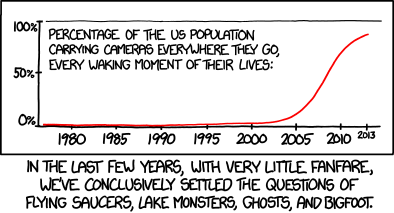 | ||
| http://www.xkcd.com/1235/ |
| Here's where the two sides of my brain collide. I need to offer citation information for xkcd. That said, this comic is totally appropriate for all audiences, but that's not the case for some of the comics on the site. Officially it's "a webcomic of romance,sarcasm, math, and language." If you decide to explore it personally, be prepared that there are some mature themes and curse words. |
Monday, July 28, 2014
Fashion Hits and Misses from YA Historical Fiction Book Covers
Part two of the fashion hits and misses from historical fiction, reposted from the Hub.
I love historical fiction. The drama, the intrigue and, oh– the fashion. I just assume all the period details regarding clothing are accurate. Or I did until my friend Liz shared it was her secret delight to troll the adult fiction section and find anachronistic apparel. Curious to know how Liz knows all that she does about fashion? Check out her bio in the first post Fashion Hits and Misses from YA Historical Fiction Book Covers.
Turns out a lot of books from specific dates and locations feature outfits as cover art that either haven’t been invented yet or were way out of fashion. I was eager to know if these same mistakes were being made in Young Adult historical fiction. After all, how was I to know? Here are some examples of books that got it right and those that got it wrong.
In Mozart’s Shadow by Carolyn Meyer

Hit, sort of – In Mozart’s Shadow: His Sister’s Story (alternate title In Mozart’s Shadow: Nannerl’s Story) by Carolyn Meyer
The novel In Mozart’s Shadow: His Sister’s Story is set in eighteenth-century Europe. Older sister Nannerl remains home in Salzburg, Austria while her brother Mozart travels and performs. How does the cover art compare?
The idea of the appropriate style of dress is there, but the quality of the fashion is poor and ill-fitting. This particular dress looks like one you would wear for an “old-timey” photo. The style of the time was a low-necked gown made from woven silks in elaborate patterns worn over panniers, a cage-like garment which extended the hips at the sides. The bodice would be tightly fitted over a stiff pair of stays, known by modern terminology as a corset. The front of the bodice exposed a stomacher, which was a triangle-shaped piece which was elaborately decorated. Sleeves were normally close-fitting and worn to the elbow with ruffle and lace embellishments. The skirt was often open in the front to expose the petticoat which was decorated to match. There were several different types of dress worn at the time, but most did follow the same silhouette as described here.
MMA 1750-1775, Purchase, Irene Lewisohn Bequest, 1959

This Robe à la Française is from the Heilbrunn Timeline of Art History which includes French fashion from 1600–1800 A.D.
Nannerl as a Child, by Peter Anton Lorenzoni, 1763

For more appropriate eighteenth-century gowns that might have been worn by Nannerl see Liz’s Pinterest page: Young Ladies Fashions 1756-1781
Miss – My Super Sweet Sixteenth Century by Rachel Harris
My Super Sweet Sixteenth Century by Rachel HarrisMy Super Sweet Sixteenth Century by Rachel Harris is set in modern times. With time travel, Cat Crawford ends up in 16th century Italy. The dress featured on the cover is from the 18th century and continued to thrive as a major force in art into the period of this book.The dress featured on the cover is from the eighteenth-century and could have been worn by Nannerl in the previous book example. The sixteenth-century, on the other hand, is known for the silhouette of an inverted triangle found in the bodice above a wide triangle shaped skirt. The fronts of the bodices were completely flat hiding the curve of the bust. This silhouette was created by a pair of bodies, also known as stays in the seventeenth and eighteenth centuries and then as a corset from the nineteenth-century to present. The pair of bodies of this period maintained its flat front by a center busk (a flat piece of wood, metal, bone, or scrimshaw). The skirts were full and cartridge pleated into a waistband and worn over a form of hoopskirt called a farthingale, which created the large triangle-shape on the bottom. Skirts were often open at front to expose a decorative underskirt. Although by description this does sound similar to eighteenth-century dress, in reality they were quite different as can be seen in the image examples.

Portrait of a Woman, mid-16th c. Florence, Italy (exact artist unknown, possibly Francesco Salviati and, more plausibly, to Michele di Ridolfo Tosini), MMA, The Friedsam Collection, Bequest of Michael Friedsam, 1931 (32.100.66)
Portrait of a Woman, mid-16th c. Florence, Italy
Portrait of Eleanor of Toledo and Her Son, ca. 1545, Agnolo di Cosimo (Il Bronzino), Uffizi Gallery, Florence


If you want to learn more about 18th century fashion try:http://www.yalsa.ala.org/thehub/2014/04/01/fashion-hits-and-misses-from-ya-historical-fiction-book-covers-part-2/
- Dress in Eigteenth-Century Europe 1715-1789 by Aileen Ribeiro
Or for a more colonial look:
- What Clothes Reveal: The Language of Clothing in Colonial and Federal America by Linda Baumgarten
Wednesday, July 16, 2014
Sharing is Caring - Technology, Privacy and The CIrcle
The repost to my most recent AISL blog..Sharing is Caring
Wednesday, May 14, 2014
Research means...
Here's my most recent AISL post, reviewing a session that I attended last month on preparing students for college-level research. I'd love feedback on the types of research you did in college, your preparedness, and (gulp) whether you used the help of librarians to complete your work. http://aislnews.org/?p=1287

Where do you go first?
Thursday, May 8, 2014

Wednesday, May 7, 2014
Return your library books

Books are due. So the option is to change my attitude or to change the expectation that books will return of their own accord as the school year winds down. One thing I am looking forward to as more of the collection is digital is less time chasing down students for items they don't always remember borrowing.
Anyway, as I've said 1000 times to students already this week, "I'm not mad. I'm actually really glad you're using the library. I just want the books back. And if you're still reading them, tell me and I'll renew them and stop bugging you."
Oh, and "Don't lie if you've lost the book.
There was a bright stop on the horizon recently when I asked the Middle Schoolers who had books with them in their cubbies and left the building with an Ikea bag chock full of titles. (Even one that had survived a backpack battle with a stick of deodorant. Mmmm...freshness.) Small victories!
For everyone else,

Thursday, May 1, 2014
Coldplay hides lyrics in libraries
Coldplay announce lyric sheet treasure hunt for Ghost Stories album
The words to all nine of Ghost Stories' songs have been concealed in haunted tales at libraries around the world
http://gu.com/p/3zndd

"¡Ándale! ¡Ándale!"Coldplay tweeted yesterday, sending their Mexican fans on a race to the English literature section of the city's Vasconcelos library. There, in a translated copy of Charles Dickens' A Christmas Carol, a lucky scavenger found Chris Martin's lyrics for Ghost Stories' lead single, Magic.
The rest of the eight sets of lyrics are in unnamed cities "across the planet", from national capitals to a a town of less than 100,000 people. One of the envelopes also includes a "golden ticket" – with a flight to see Coldplay perform at London's Royal Albert Hall on 1 July. Hopefully it's not just hidden in Birmingham.
Martin discussed Ghost Stories on BBC Radio 1 on Monday night, admitting to Zane Lowe that this sixth album was heavily influenced by his split with Gwyneth Paltrow. "I think everyone in their life goes through challenges, whether it's love or money, kids, or illness," he said. "You have to really not run away from that stuff."
Martin also revealed that he blames himself for the dissolution of their marriage. "About two years ago I was a mess, really, because I [couldn't] enjoy the things that we [were] good at and I [couldn't] enjoy the great things around me because I [was so] burdened by this," he said. "[I thought] I've got to not blame anyone else and make some changes."
Martin and Paltrow, who share a nine-year-old daughter and an eight-year-old son, initially described their separation s a "conscious uncoupling". "It's not a question of you either really love someone or you really hate someone," Martin said. "Especially with the modern world's complications - like travelling and all the stuff that comes to life, and illness and addiction and all that sort of thing."
Sunday, April 27, 2014
AISL Dallas Highlights
I just returned from an amazing conference, and I promise (well, kind
of, since I tend to have many blog ideas and only few blog posts) more
in the future. The Association for Independent School Librarians is
geared towards people just like me, and each year the conference is held
in a different city. Schools work together to plan and host. You get to
hear fabulous speakers, network with librarians, meet authors, and tour
schools. Next year, the conference will be held in the Tampa Bay area,
and we've already been working since last spring to make it an event
well worth attending.
Here's a quick 10 list of some of the highlights from Dallas this year.


.jpg)

Here's a quick 10 list of some of the highlights from Dallas this year.
Texans love to display their "Texasness." Many cute library displays were seen.
What do do with weeded books? Ask your art students. This is well done and poignant.
Why do I sometimes feel my library is tiny? Libraries like this one, which extends back about a third as far past this picture. Fun fact: This is Luke and Owen Wilson's alma mater.
Texas Christian University (Go Horned Frogs!) has these technology-enabled "frog ponds" for small group projects. They are sound-buffered, not sound-proof.
At one elementary school, each student had a poem tied to his or her waist. April 24 is "Poem in your Pocket" day, part of National Poetry Month. This girl was thrilled to share hers.
I loved Lyle, Lyle Crocodile as a child! The same school has a budget for yearly author visits. The list was impressive, and I'd love to bring more authors to Saint Stephen's.
Any thoughts? I think I want these for the library. Not only the chair with a media desk but also the end table with plugs next to it.
This school just (as in two days previously) finished its library/makerspace combo. It was huge, with loads of print books and also fish, snakes, spiders, and turtles. Plus, there was an amazing corner that encourages kids to create with technology, not just consume it.
Here are a few of the stations. There were several 3d printers, a video production lab, a whiteboard brainstorming station, and many more computers.
This is a section of the makerspace with zen rock pillows, a video game system that uses movement technology, and sound-buffering panels that are multicolored and can be switched from orange to gray.
Libraries are still vibrant, and librarians are still working hard to improve learning across the curriculum. Great job, Team Dallas!
Thursday, April 3, 2014
Why is Florida always in the news for the wrong reasons?
PORT ORANGE, Fla. —
“She had a pretty good-sized wound on the back of her head,” said Volusia County spokesperson Dave Byron.
County officials placed numerous signs outside the library warning people about the aggressive birds.

Workers at the library told Channel 9’s Julie Salomone they’re stocking up on umbrellas for guests to use as protection against the hawks.
County officials said a nearby nest has made the hawks more protective.
“Luckily I ducked right before it got to me, and it flew over my head and onto the top of the building,” said library guest Don Cornejo.
The family of hawks lives in a tree next to the building and there are at least two babies in the nest.

The adult birds fly to the ground and attack people as they approach the library, according to library workers and guests.
The county is urging visitors to always use umbrellas as they walk to and from the library after several reports of the birds getting too close and injuring people.
The county shared a picture with Salomone, showing where one woman was scratched on the head by the birds.
Florida Fish and Wildlife officials said the hawks are protected and in some cases officials will come out and remove the nests, but not in this case.
The red-shouldered hawk is one of the most common hawks in the state.
County officials said the birds should be less aggressive in about three weeks, once the baby hawks are out of the nest.
From the Daytona Beach News Journal
Saturday, March 29, 2014
Apples with Catchy Names...
This is the type of research I find fascinating, and not just because it relates to food. Human psychology, consumer behavior, and taste perception are all referenced.
http://www.news.cornell.edu/stories/Nov11/CALSAppleNames.html
Apples with catchy names may boost revenue for farmers
ProvidedN.Y. Sen. Kirsten Gillibrand, left, tastes an NY1 apple alongside its breeder, Susan Brown, professor of horticultural sciences, at the 2010 New York Farm Days event in Washington, D.C.
ProvidedThe NY1 apple.


A rose by any other name may smell as sweet, but an apple by another name could fetch a much sweeter price for farmers.
Using experimental auctions, researchers at Cornell University's Charles H. Dyson School of Applied Economics and Management tested participants' willingness to pay for five different varieties of apples, including a new, patented variety developed at Cornell, currently named NY1. Participants didn't know about the apples' history or the Cornell connection, but they learned about each variety's attributes, such as sweetness and crispness, and they tasted slices of each.
The researchers' conclusion? Consumers were willing to pay more for NY1, and they were willing to pay still more when it had an "exciting, sensory" name, said assistant professor Bradley J. Rickard. He presented the research Nov. 8 at the New York Produce Show and Conference in New York City.
Rickard and co-authors Todd Schmit, Miguel Gómez and Hao Lu, all of the Dyson School, wanted to test the influence of branding on patented fruit varieties.
"There are a lot of brands throughout the grocery store. The one exception is fresh produce," Rickard said. "But in the case of apples, pears, tomatoes and peaches, that's the one place in the fresh produce sector where you have a choice. Not really across brands, but across these varietal names."
And what's in a name? Quite a bit, it turns out.
Apple names generally fall into three categories, Rickard said: sincere names based on a breeder or location, such as Cortland or Granny Smith; sophisticated names, which usually highlight the fruit's appearance, such as Red or Golden Delicious; and exciting names that evoke the taste or texture of the apple, such as Honeycrisp.
In the experimental auction, the researchers tested the new Cornell apple under three names: sincere "Williams," sophisticated "Burgundy Beauty" and exciting "Flavor Haven."
In all cases, the average bid for the new apple was 12 percent higher than the average for four other apples (Empire, Fuji, Honeycrisp, and Piñata). With the Flavor Haven name, the average bid jumped to 27 percent over the other varieties.
Perhaps most interesting, Rickard said, bids on NY1 influenced bids on the other new, patented Washington apple, Piñata, but made no difference in bids on the traditional varieties.
New York grocery shoppers already enjoy a wide selection of apples -- including some of the 66 varieties developed at Cornell, such as Cortland, Empire, Macoun and Jonagold -- but new, patented varieties are starting to hit shelves. These varieties often sell for a premium, but they're also more expensive to grow, as farmers have to buy licenses to grow them.
Historically, public universities developed new apple breeds and released them to the public. But in 1980, the Bayh-Dole Act gave universities the right to retain the intellectual property rights for their research. In May 2010, Cornell forged a partnership with a new industry group, the New York Apple Growers LLC, to establish an exclusive licensing agreement for the new apple varieties, NY1 and NY2.
"The license will entail some fairly substantial upfront fee. It could be $1,500 an acre upfront," Rickard said. "Then once you sell a box of fruit, you also need to pay a royalty."
Rickard's primary research interest is determining the best price and setup for that license. In September, he was awarded a two-year, $348,700 USDA grant to study that topic.
Krisy Gashler is a freelance writer for the College of Agriculture and Life Sciences.
http://www.news.cornell.edu/stories/Nov11/CALSAppleNames.html
Subscribe to:
Posts (Atom)

