
Posted Monday, October 20, 2014 - 10:55
Showing posts with label Information Literacy. Show all posts
Showing posts with label Information Literacy. Show all posts
Wednesday, October 18, 2017
Conflicted thoughts about a presentation that was "Mostly True"
Thoughts on a recent presentation and the current news cycle on today's AISL post.
Wednesday, October 19, 2016
"They said WHAT?" Elections and Information Literacy
What are some ways that schools can open up the conversation peacefully and thoughtfull during election season? Keep reading: http://aislnews.org/?p=4643
Wednesday, May 18, 2016
Information Literacy and TRAILS
Some end-of-year reflections on information literacy and TRAILS: http://aislnews.org/?p=4126What do we mean by Information Literacy anyway?
Thursday, November 6, 2014
Just Curious...
I read this recently and it resonated with me. Why do people feel ashamed to not know something already? What not ask for help finding whatever it is that piques your curiosity? I will be trying to model this in my own life when students have questions. And questions they have aplenty....
Just Curious
When a simple phrase is not as innocent as it seemsBy Joseph Janes

The other day, I was writing yet another email and was rattling off a bunch of stuff, answering questions, asking a few, the way one does. As I wrapped up, I remembered there was something that had been in the back of my mind, so I tossed that in at the end, prefacing it with the innocuous “Y’know, I wondered about such-and-such … nothing important, just curious.”
We’ve all done that a thousand times. On the surface, “just curious” is one of those phrases that doesn’t really mean anything and gets tossed in just to signal that a question isn’t urgent or immediate or that it doesn’t connect to any larger matter. Which is fine on its face and is, in most cases, harmless.
Somehow, though, I started to actually think about what it means and what it really says. (Columnists’ occupational hazard? Signal that it’s time to stop doing email? Likely both.) Peel away a layer or two, and this looks less innocent.
Why “just” curious? Why this dismissive portrayal of curiosity? Isn’t curiosity a good thing? Yes, I know I’m overanalyzing this. But follow me for a minute. This gets stuck into questions and inquiries all the time; you’d hear it at a retail counter, in conversation or a meeting, or in a reference setting, and I think it bespeaks a more subtle phenomenon.
Way back in the Pleistocene era, when I was running the Internet Public Library, we were examining reference questions that had come in through the IPL’s intake form. It asked for the question, of course, along with name and email address, and more substantive things like geographic location and what sources people had already tried. Standard reference-interview practice, and since this was usually a one-shot opportunity to hear from the client, the form was pretty extensive.
After looking at a bunch of submissions, we noticed something: To try to scaffold these queries, to help people better understand their own information needs and us to better respond, we asked another question, on the person’s situation or reason for asking. Not in a challenging way, but to help so that we had some sense of how the response might be used. Some of these were blank, and others—many others—gave us versions of “just curious” and many of those gave the impression that people were sheepish or even embarrassed about being … just curious. As though asking for their rationale made it sound as if the rationale wasn’t good enough or that we wouldn’t take them seriously.
Well. My first response was to rephrase the form text to say “It’s okay to be just curious!” which seemed to help. This episode has stayed with me, and upon reflection, it feels like for many, curiosity is an undervalued, or even belittled commodity.
We are all about curiosity; we’re in the curiosity business. Much, if not all, of what we provide is meant to satisfy curiosity about matters small and large, and indeed itself is the result of the curiosity of authors and creators. Not to mention lots of us got into this field because we’re the curious type too. Guilty as charged.
So here’s my proposal: From here on, in any professional setting, when you hear “just curious,” respond thus: “Isn’t that great? Curiosity is a wonderful thing; let’s find that out together.” Or perhaps something less chirpy; reword as necessary.
Every quarter, I pounce on the first poor soul who says, “This is a stupid question, but.…” That barely gets out before I say, “The only stupid questions are the unasked ones.” (If only that were true … but that’s another story.)
JOSEPH JANES is associate professor and chair of the Information School of the University of Washington in Seattle.
Thursday, August 7, 2014
Conspiracy? Hoax? The Truth?
I came across this comic this summer, and I've thought about it frequently since that point. Do ubiquitous internet-enabled devices support or undermine conspiracy theories? I find it common that people refer to information submitted to the Internet as "proof." Web evaluation skills are needed more than ever in this day and age.
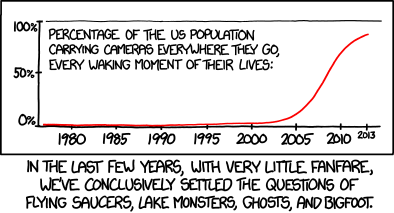 | ||
| http://www.xkcd.com/1235/ |
| Here's where the two sides of my brain collide. I need to offer citation information for xkcd. That said, this comic is totally appropriate for all audiences, but that's not the case for some of the comics on the site. Officially it's "a webcomic of romance,sarcasm, math, and language." If you decide to explore it personally, be prepared that there are some mature themes and curse words. |
Wednesday, February 27, 2013
Ask a Librarian Chat Reference
This is a service you should use for reference questions, even despite what I'm about to write. http://www.askalibrarian.org/
I think this is an important exchange for two reasons. First, tone is so hard to decipher in purely written documents. This is something I teach in digital citizenship classes, but it really comes through in this case. Second, this shows what a good librarian (better than me) can quickly do to help your research.
A student wanted to use a Mike Tyson quotation in his paper, and I told him that he couldn't unless he had it verified on something other than a sports news site. Here is the quotation if you want to play along at home.
"Everyone has a plan/strategy until they’ve been hit/punched (in the face/mouth)”
Rhonda, an academic librarian who moonlights at a virtual reference librarian, you made my day. Not only did you find an original source of the quotation, you also directly me to Arlington Cemetery resources for more information.
Use librarians for research help; they give you information!
I think this is an important exchange for two reasons. First, tone is so hard to decipher in purely written documents. This is something I teach in digital citizenship classes, but it really comes through in this case. Second, this shows what a good librarian (better than me) can quickly do to help your research.
A student wanted to use a Mike Tyson quotation in his paper, and I told him that he couldn't unless he had it verified on something other than a sports news site. Here is the quotation if you want to play along at home.
"Everyone has a plan/strategy until they’ve been hit/punched (in the face/mouth)”
You have been connected to Bryan W - Pasco County Library System.
Bryan W - Pasco County Library System: Hi Christina, I would check the footnotes in the bibliography in the back of the book. This will usually state where or when the quote was said originally.
Christina: It's not in a book. It's on business and sports sites. Can't find the original.
Bryan W - Pasco County Library System: I would try checking the site to see if it is stated anywhere on that site. I would also recommend navigating the Internet a little bit to see where it is mentioned. Youtube may even have interviews that state when and where certain quotes were said.
Christina: Yes, I have done all of that.
Christina: It seems to be an aphorism at this point.
Christina: I have also limited by date to only get earlier references, but there is no original.
Christina: I have also tried quote and phrase dictionaries.
Bryan W - Pasco County Library System: Well in that case I see what you mean. This may have been a quote that could have been said at anytime or place. There have also been various books written on Mike Tyson that may have that quote in them. However if this is a question based strictly on websites I do not know if that will help. Google Scholar may also work for you, it has a lot of information on various topics.
Bryan W - Pasco County Library System: Can I help you with anything else today?
Christina: I would still like to find the origin of the quote. There is nothing on google scholar either.
Bryan W - Pasco County Library System: I will try checking a little bit more hold on
Bryan W - Pasco County Library System: It seems like this could have been said anywhere at any time almost like it was never documented.
Christina: okay. Thank you.
Bryan W - Pasco County Library System: Your welcome. Hope this helped a little.
Bryan W - Pasco County Library System: Thank you for using Ask a Librarian, and we hope you come again.
Bryan W - Pasco County Library System has left the session.
Your librarian is experiencing technical difficulties. Please stand by while we re-establish contact or find a new librarian...
Please wait while we find a librarian to assist you.
You have been connected to Rhonda T - NWFSC.
Rhonda T - NWFSC: Hello, welcome to Ask a Librarian. I am Rhonda T - NWFSC and I will be assisting you today. Please wait a moment while I consider your question...
Rhonda T - NWFSC: This is the information I found and I will send you the URL
Rhonda T - NWFSC: "Everyone has a plan/strategy until they’ve been hit/punched (in the face/mouth)” is a boxing adage meaning that brutal reality can change even the best of prepared plans. A similar saying exists about military planning—“No plan survives contact with the enemy.” The boxing/military saying has also been used in business, government and other fields. “Everyone has a plan until they’ve been hit” has been credited by Wikipedia to the boxer Joe Louis (1914-1981), but it’s not clear if he ever said it.
Brooklyn-born boxer Mike Tyson is most frequently credited with the saying. In October 1987, HBO’s Barry Tompkins quoted Mike Tyson as saying, “They all have a plan...until they get hit.”
The librarian is sending you to http://www.barrypopik.com/index.php/new_york_city/entry/everyone_has_a_plan_until_theyve_been_hit_boxing_adage/.
Christina: Thank you!
Rhonda T - NWFSC: It looks like the quote is from the 1930-40s and was by Joe Louis.
Christina: Wow. Very interesting. It seemed like sloppy journalism that no one mentioned where the quotation originated.
Rhonda T - NWFSC: They get changed - that is the power and craziness of the Internet. One sec. I may have more.
The librarian is sending you to http://www.arlingtoncemetery.net/joelouis.htm.
Rhonda T - NWFSC: trying to find the first mention of it
Rhonda T - NWFSC: sorry -
The librarian is sending you to http://www.tysontalk.com/quotes/quotes-by-mike-tyson.
Rhonda T - NWFSC: This is a place it was attributed to Tyson, but there are no references to back it up.
Christina: That makes sense. This is more than I needed. Thank you so much!
Rhonda T - NWFSC: Welcome!
Rhonda T - NWFSC: Thank you for using Ask a Librarian, and we hope you come again.
Thank you for using Ask a Librarian. You may now close this window.
Rhonda, an academic librarian who moonlights at a virtual reference librarian, you made my day. Not only did you find an original source of the quotation, you also directly me to Arlington Cemetery resources for more information.
Use librarians for research help; they give you information!
Monday, November 26, 2012
Wikipedia and JSTOR partners
Since JSTOR chose to allow access for 100 wikipedia editors, I can guess that it was a publicity move. Even so, I'm happy to drink the kool-aid or at least stir in the powder.
Wikipedia is commonly used, and it's important that it be as accurate as possible, which means giving editors access to reputable information and scholarship. My one question involves the type of information published on JSTOR. The database is most useful for scholarly articles, while wikipedia should be focusing on general explanations.
JSTOR provides free access to Wikipedia editors via pilot program
http://blog.wikimedia.org/2012/11/19/jstor-provides-free-access-to-wikipedia-editors/
Wikipedia is commonly used, and it's important that it be as accurate as possible, which means giving editors access to reputable information and scholarship. My one question involves the type of information published on JSTOR. The database is most useful for scholarly articles, while wikipedia should be focusing on general explanations.
JSTOR provides free access to Wikipedia editors via pilot program
Posted by Steven Walling on November 19th, 2012One of the challenges facing the volunteer editors of Wikipedia is finding reliable sources to use as reference material — in our last editor survey, 39 percent named this as one of the largest problems hindering their contributions. The need was especially pronounced among our most active volunteers, who make hundreds or thousands of edits per month.Prolific Wikipedians strongly favor access to more research materials, according to our December 2011 Editor Survey
To address this issue, the Wikimedia Foundation is collaborating with JSTOR, a service of the not-for-profit organization ITHAKA, to provide 100 of the most active Wikipedia editors with free access to the complete archive collections on JSTOR, including more than 1,600 academic journals, primary source documents and other works. The authors who will receive accounts have collectively written more than 100,000 Wikipedia articles to date. Access to JSTOR, which is one of the most popular sources on English Wikipedia, will allow these editors to further fill in the gaps in the sum of all human knowledge.
While some Wikipedia volunteers may already receive access as part of their professional affiliations or through institutions like public libraries, this access is far from universal. This program will empower some of our most active editors to create new content on the huge variety of topics covered by the journal archives on JSTOR. Access during the pilot will be for a year, after which JSTOR and Wikimedia will collaborate on potentially expanding the program.
Wikipedia contributors beyond the pilot group can also take advantage of growing access, as can readers. JSTOR provides free access to Early Journal Content and recently introduced Register & Read, an experimental program to offer free, read-online access to individual scholars and researchers who register for a MyJSTOR account. More information may be found at about.jstor.org/individuals.
While Wikipedians are volunteers, their work on the encyclopedia is most definitely of a scholarly nature. We hope that this pilot will show that amazing things can happen when you provide dedicated volunteers with access to great source material.

http://blog.wikimedia.org/2012/11/19/jstor-provides-free-access-to-wikipedia-editors/
Wednesday, October 10, 2012
Information Literacy
I totally agree with this statement from Gaggle.net founder Jeff Patterson.
When you're talking about the past, you're talking all about libraries and card catalogs. It was hard to find the information when I was a kid. Now, there's an abundance of information. It's hard to determine whether it's accurate information, authoritative information and then to interpret that information.One of the challenges - we always struggle with this - is, what is really accurate information? What is the right information and the relevant information? Those are big challenges, and how to interpret what it means. So sometimes it can be a real challenge to look for.For example, it's the new year, and I'm looking to lose a little bit of weight. I pulled out the old bathroom scale, and every time I get on it, within a 5-minute period, it will show a variance of 3 pounds, and it's just frustrating. So I've been Googling bathroom scales and accuracy, and I can find out all sorts of new scales to buy, but to find out why my bathroom scale doesn't work right is hard.So to me, literacy is being able to find the right relevant information and interpret it; who's trying to sell me something, who has an agenda. Those are real challenges, even for us well-educated adults.
Evaluation needs to be a part of our lives. It's not just a school skill; it's a life skill.
Media Literacy
I totally agree with this statement from Gaggle.net founder Jeff Patterson.
When you're talking about the past, you're talking all about libraries and card catalogs. It was hard to find the information when I was a kid. Now, there's an abundance of information. It's hard to determine whether it's accurate information, authoritative information and then to interpret that information.One of the challenges - we always struggle with this - is, what is really accurate information? What is the right information and the relevant information? Those are big challenges, and how to interpret what it means. So sometimes it can be a real challenge to look for.For example, it's the new year, and I'm looking to lose a little bit of weight. I pulled out the old bathroom scale, and every time I get on it, within a 5-minute period, it will show a variance of 3 pounds, and it's just frustrating. So I've been Googling bathroom scales and accuracy, and I can find out all sorts of new scales to buy, but to find out why my bathroom scale doesn't work right is hard.So to me, literacy is being able to find the right relevant information and interpret it; who's trying to sell me something, who has an agenda. Those are real challenges, even for us well-educated adults.
Monday, October 1, 2012
Vonnegut is very real
As a librarian, it's no surprise that I'm anti-censorship and am celebrating Banned Books Week from September 30 through October 6th.
This letter from Kurt Vonnegut to the head of a school board that wanted to ban his book Slaughterhouse Five just blew my mind. Woah!
November 16, 1973
Dear Mr. McCarthy:
I am writing to you in your capacity as chairman of the Drake School Board. I am among those American writers whose books have been destroyed in the now famous furnace of your school.
Certain members of your community have suggested that my work is evil. This is extraordinarily insulting to me. The news from Drake indicates to me that books and writers are very unreal to you people. I am writing this letter to let you know how real I am.
I want you to know, too, that my publisher and I have done absolutely nothing to exploit the disgusting news from Drake. We are not clapping each other on the back, crowing about all the books we will sell because of the news. We have declined to go on television, have written no fiery letters to editorial pages, have granted no lengthy interviews. We are angered and sickened and saddened. And no copies of this letter have been sent to anybody else. You now hold the only copy in your hands. It is a strictly private letter from me to the people of Drake, who have done so much to damage my reputation in the eyes of their children and then in the eyes of the world. Do you have the courage and ordinary decency to show this letter to the people, or will it, too, be consigned to the fires of your furnace?
I gather from what I read in the papers and hear on television that you imagine me, and some other writers, too, as being sort of ratlike people who enjoy making money from poisoning the minds of young people. I am in fact a large, strong person, fifty-one years old, who did a lot of farm work as a boy, who is good with tools. I have raised six children, three my own and three adopted. They have all turned out well. Two of them are farmers. I am a combat infantry veteran from World War II, and hold a Purple Heart. I have earned whatever I own by hard work. I have never been arrested or sued for anything. I am so much trusted with young people and by young people that I have served on the faculties of the University of Iowa, Harvard, and the City College of New York. Every year I receive at least a dozen invitations to be commencement speaker at colleges and high schools. My books are probably more widely used in schools than those of any other living American fiction writer.
If you were to bother to read my books, to behave as educated persons would, you would learn that they are not sexy, and do not argue in favor of wildness of any kind. They beg that people be kinder and more responsible than they often are. It is true that some of the characters speak coarsely. That is because people speak coarsely in real life. Especially soldiers and hardworking men speak coarsely, and even our most sheltered children know that. And we all know, too, that those words really don’t damage children much. They didn’t damage us when we were young. It was evil deeds and lying that hurt us.
After I have said all this, I am sure you are still ready to respond, in effect, “Yes, yes–but it still remains our right and our responsibility to decide what books our children are going to be made to read in our community.” This is surely so. But it is also true that if you exercise that right and fulfill that responsibility in an ignorant, harsh, un-American manner, then people are entitled to call you bad citizens and fools. Even your own children are entitled to call you that.
I read in the newspaper that your community is mystified by the outcry from all over the country about what you have done. Well, you have discovered that Drake is a part of American civilization, and your fellow Americans can’t stand it that you have behaved in such an uncivilized way. Perhaps you will learn from this that books are sacred to free men for very good reasons, and that wars have been fought against nations which hate books and burn them. If you are an American, you must allow all ideas to circulate freely in your community, not merely your own.
If you and your board are now determined to show that you in fact have wisdom and maturity when you exercise your powers over the eduction of your young, then you should acknowledge that it was a rotten lesson you taught young people in a free society when you denounced and then burned books–books you hadn’t even read. You should also resolve to expose your children to all sorts of opinions and information, in order that they will be better equipped to make decisions and to survive.
Again: you have insulted me, and I am a good citizen, and I am very real.
Kurt Vonnegut
No response from the school board.
This is reposted from a neat blog of letters, particularly "correspondence deserving of a larger audience. It can be found here: http://www.lettersofnote.com/2012/03/i-am-very-real.html.
This is reposted from a neat blog of letters, particularly "correspondence deserving of a larger audience. It can be found here: http://www.lettersofnote.com/2012/03/i-am-very-real.html.
Tuesday, February 28, 2012
Real-life lessons on information literacy
The trending news stories across the top of the Yahoo page are designed to attract your attention. They rotate quickly, leaving you seconds to decide if you want to click and find out more or if you want to continue on to your intended destination. (In my case, my email.)
Have you noticed that photos of fashion don't include the item in question? Click to learn more. Want to learn what two new celeb parents named their child? Click to learn more. Unorthodox solutions for chapped lips? Click to learn more.

Have you noticed that photos of fashion don't include the item in question? Click to learn more. Want to learn what two new celeb parents named their child? Click to learn more. Unorthodox solutions for chapped lips? Click to learn more.
Think about the change from the old days when the headline hooked you into reading more, but also gave more clues about what to expect. But more clicks mean higher ad revenue, and curiosity is a great a great attention-grabber. And it ties (again) into librarians' relevance today. Without editors and fact checkers, how do you know if what you're learning is true?
The big story trending yesterday played into the 99% movement and Occupy Wall Street. At a California restaurant, a banker left a 1% monetary "tip" and a "tip" to get a real job. Turns out Photoshop may have played a role. According to today's news, the whole thing was a publicity hoax.

Here's the thing. Does it matter to the news sites if the news is correct if we're reading the stories anyway? Will some people who were angered by the sentiment of the first receipt still carry some of that anger even though the story is false? Will news sites give me any kind of security that they're making efforts that this sort of thing won't happen again.
Also, as a librarian, I fully realize that there's no reason I should trust either of these receipts. If I wanted to know the truth, I would probably check the local newspaper in Newport Beach or call the restaurant. (Really, I'm not beyond wondering if the restaurant perpetuated this as a way to get publicity.) Having visited the restaurant's website, I can tell you that meals are between $7 and $22, so it's more likely that a banker actually left a 22% tip on a $33 check than that he left a $1 tip after buying lunch for all his friends.
Information literacy lesson that going straight to my students? Absolutely!
Subscribe to:
Posts (Atom)

